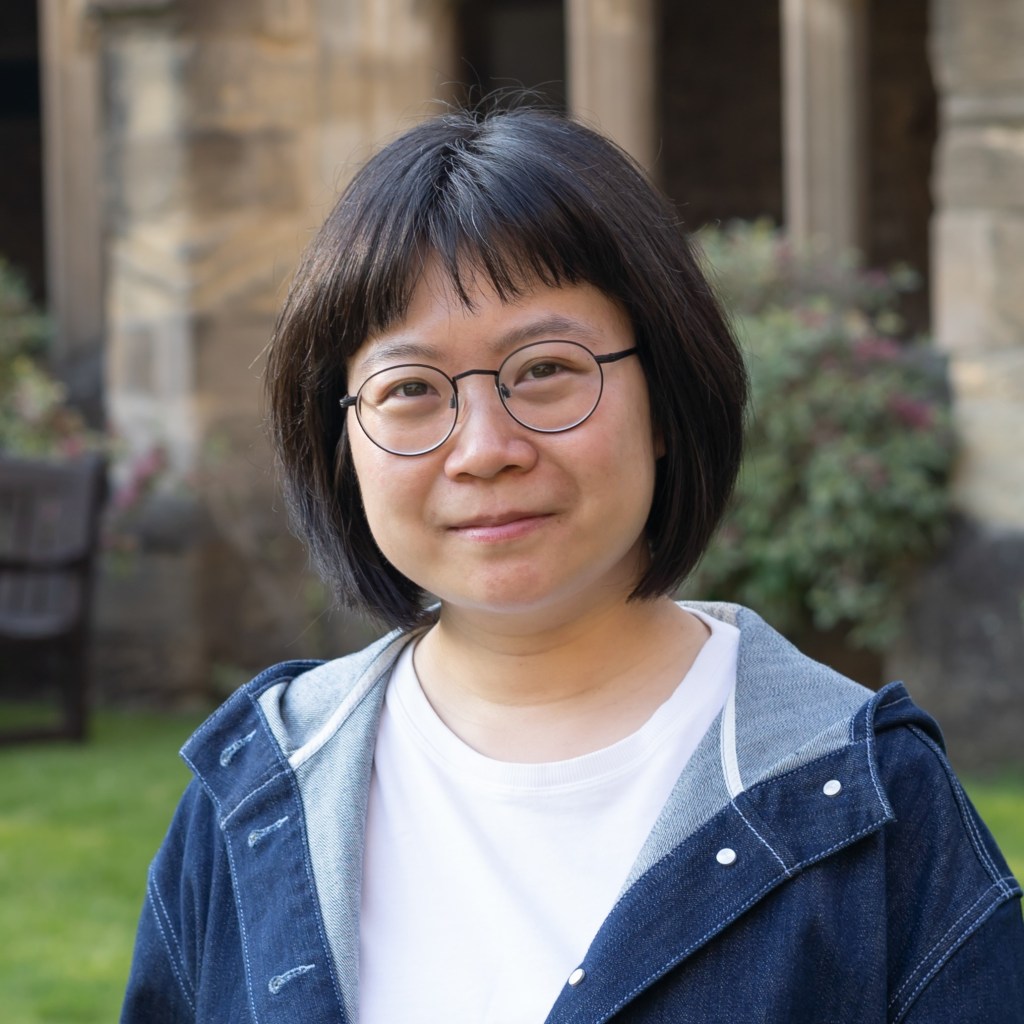
Since 2020, I am a postdoc working with Prof. Masud Husain at University of Oxford, studying the mechanisms underlying motivation and cognition in both health and dementia.
Before coming to Oxford, I did BSc Neuroscience, MSc Computer Science and my PhD Auditory Neuroscience (with Prof. Maria Chait and Prof. Fred Dick) all at UCL. My hybrid background sparked my interest in the intersection of neuroscience, psychology, neurology and technology.
I developed OCTAL, an online cognitive testing platform designed for use across the lifespan—including those living with dementia. I hope OCTAL will benefit patients and their families, as well as researchers who, like me, have high standards for assessment tools.
I was also a popular neuroscience writer from 2013, publishing four books in China. In 2022, with the arrival of my second daughter, I happily retired from popular science writing—closing that chapter with no regrets.
sijia.zhao@psy.ox.ac.uk
Key publications
Here I’ve just included my first authored papers. Check out my complete list on Google Scholar!
🧑🏻💻 Online cognitive and perceptual testing
Harnessing digital platforms to measure and understand cognition and perception in health and disease—from COVID-19 to dementia. I explore both online and in-person testing, aiming for both large-scale reach and refined, robust assessments for smaller studies.
| Paper’s title | Journal | Year |
|---|---|---|
| OCTAL (Oxford Cognitive Testing Portal): A remote, cross-cultural cognitive assessment detects domain-specific aging and dementia | (Under review) | 2025 |
| Long COVID is associated with severe cognitive slowing: a multicentre cross-sectional study | eClinicalMedicine | 2024 |
| Relationship of plasma biomarkers to digital cognitive tests in Alzheimer’s disease [*co-first author] | Alzheimer’s & Dementia | 2024 |
| Rapid vigilance and episodic memory decrements in COVID-19 survivors | Brain Communications | 2022 |
| Robust and efficient online auditory psychophysics | Trends in Hearing | 2023 |
| An online headphone screening test based on dichotic pitch [*co-first author] | Behavior Research Methods | 2022 |
🧠 Clinical perspectives on brain health
Bridging neuroscience and medicine to explore how conditions like dementia, diabetes, and depression shape brain health. Grateful to be learning from my amazing neurologist colleagues and my supervisor Masud.
| The social dimension of apathy: Evidence for a distinct domain from 11,243 individuals across health and neurocognitive disorders | (Under review) | 2025 |
| On the relationships between apathy, depression and anhedonia | (Under review) | 2025 |
| Self-versus caregiver-reported apathy across neurological disorders | Brain Communications | 2025 |
| Preclinical type 2 diabetes mellitus subtypes: new insights into diabetes, depression and dementia | Brain | 2025 |
| Effects of COVID-19 on cognition and brain health | Trends in Cognitive Sciences | 2023 |
🎵 Auditory attention
My starting point in science—investigating how the brain deciphers patterns in sound. This is where I learned the art (and occasional monotony) of being a scientist!
| Sustained EEG responses to rapidly unfolding stochastic sounds reflect Bayesian inferred reliability tracking | Progress in Neurobiology | 2025 |
| Cross-modal interactions between auditory attention and oculomotor control | Journal of Neuroscience | 2024 |
| Pupil-linked arousal response reveals aberrant attention regulation among children with autism spectrum disorder | Journal of Neuroscience | 2022 |
| Rapid ocular responses are modulated by bottom-up-driven auditory salience | Journal of Neuroscience | 2019 |
| Pupil-linked phasic arousal evoked by violation but not emergence of regularity within rapid sound sequences | Nature Communications | 2019 |
| Pupillometry as an objective measure of sustained attention in young and older listeners | Trends in Hearing | 2019 |
🎨 Drawing and visual working memory
I love arts and eye movements!
What’s new
| June 2025 | 🧠 I don’t normally share preprints, but this one is special: our first comprehensive methods paper for OCTAL (read the preprint here). OCTAL is a remote cognitive screening tool developed for individuals with dementia. A five-minute OCTAL assessment demonstrates comparable accuracy to established in-person cognitive assessments, such as the ACE-III, in differentiating cognitive impairment from subjective cognitive symptoms. |
| April 2025 | 💬 Excited to chair the session “S10: Best of Brain and Brain Communications” at #BNA2025 in Liverpool. I will talk about “The Future of Cognitive Assessment is Now: Remote Testing for Dementia and Beyond”. |
| Feb 2025 | OCTAL’s intellectual property (IP) has been assigned to Oxford University Innovation Limited for commercialization. While I don’t expect any personal financial gain from this, I hope it will enhance OCTAL’s sustainability and keep it free for academic use! |
| Jan 2025 | The first study I conducted during my PhD (way back in January 2015) has finally been published—after 81 versions of the manuscript. It’s been a long journey, filled with love and tears. Huge thanks to Maria and Fred for their support. My main motivation for getting this paper out was to demonstrate my experience with EEG and signal processing. I wouldn’t call myself an expert anymore—I’m a bit out of date! |
| April 2023 | 💬 I will co-chair the symposium Neurologic of COVID at British Neuroscience Association 2023 in Brighton and talk about some cool (but worrying) objective cognitive testing data about post-COVID cognitive deficits. |
| April 2023 | 🏆 Got three rewards in popular science in China. Lazy to translate those titles. But one of them came with an amazing trophy! (post on twitter) |
| Feb 2023 | 💬 My honor to speak at Neuromodulatory systems in auditory processing in SCAN (Symposium for Cognitive Auditory Neuroscience). My presentation title is “The Role of Norepinephrine in Auditory Perception”. |
| May 2022 | 📜 My pupillometry paper on autism–collaborated with Prof Kunlin Wei in Peking University—- is published on Journal of Neuroscience! |
| April 2022 | 👶 My baby #2 was born this spring. She is Lily. Her Chinese name is 百荷; it means “hundreds of lotuses”. She is very cute. Now, I am a mother of two under two. |
| April 2022 | 📖 I published two new books in China this month. Very happy with them. I’m calling it quits on popular scientific writing for the time being. |
| Jan 2022 | 📰 Our finding about months-long attention and memory deficits among young COVID-19 survivors is featured by University of Oxford, Reuters, The Independent (UK), Spiegel (Germany), 朝日新聞 (Japan) and more! |
| July 2021 | 💡 Running auditory experiments online and want to find a way to set sound presentation levels for your online participants? Here is a must-read: Zhao et al. (2022). Robust and Efficient Online Auditory Psychophysics. on Trends in Hearing. The sound volume setting task is available on Pavlovia and Gorilla |
| Aug 2020 | 👶 Something personal… After a few academic babies, I now have a biological baby. Preferred citation: Zhao and Chan (2020) Yurika Zhao. Queen Charlotte’s and Chelsea Hospital, London. |
| July 2020 | Thinking of running online experiments with sounds? Want to confirm that listeners are wearing headphone? Try our new headphone screening test! Read our paper for more details. And if you use Pavlovia, I made a website to add the test automatically for you! |
| June 2020 | I am joining Masud’s lab at University of Oxford! |
| June 2019 | Attending Interdisciplinary Advances in Statistical Learning 2019 in San Sebastian, Spain, supported by a travel grant from the Guarantors of Brain. I will present a poster (#PS-3.19) between 11:20–12:40 on Saturday 29th June at the Miramar Palace. |
| May 2019 | Attending Biology of Decision Making (SBDM) at University of Oxford, England. I will present a poster (#123) on Wednesday. Come along if you are interested in pupil dilation and/or uncertainty! |
| Nov 2018 | Attending Attention to Sound organised by The Royal Society at Chicheley Hall, Newport Pagnell, England. |
| June 2018 | I was awarded with Brain Travel Award to present my poster Sensitivity to Pattern Changes in Rapid, Stochastic Tone Sequences at the 8th Mismatch Negativity conference in Helsinki, Finland. |
| 20 April 2018 | I passed my viva with no corrections! Yay! |
| Mar 2018 | Presenting my poster at Cognitive Neuroscience Society in Boston, US. Met my academic grandpa David Poeppel (Maria’s PhD supervisor). |
| Dec 2017 | My book Guide to the Brain is now also available in Traditional Chinese, in Hong Kong, Macau and Taiwan. |
| Sep 2017 | Gave a lecture on pupillometry to PhD students from INTERLEARN, Center for Brain and Cognitive Development at Birkbeck, University of London. |
| Sep 2017 | Presenting my work at the International Conference on Auditory Cortex in Banff, Alberta, Canada. |
| Feb 2017 | Presenting three posters at the 2017 Association for Research in Otolaryngology (ARO), in Baltimore, US. ARO is one of the biggest conference for auditory guys (like me). |
| Oct 2016 | My popular neuroscience book 大腦使用指南 (Guide to the Brain) is published in China! It’s the first neuroscience book written by a mainland writer (me!). |
| Sep 2016 | 3-month academic visit at NTT, Atsugi, Japan. |
| Feb 2016 | Gave my first talk at 2016 ARO, in San Diego, US. |
| Jan 2015 | Starting PhD in Auditory Neuroscience at UCL Ear Institute, supervised by Maria Chait and Fred Dick. |
 Dr Sijia Zhao